Every ultrasound/ pregnancy scans are very important as per the baby growth and development and the each trimester stages; apart from all the pregnancy scan/ ultrasound scans Nuchal Translucency Scan has a unique place; look at why??:
What is meant by Twin Nuchal Translucency Scan?
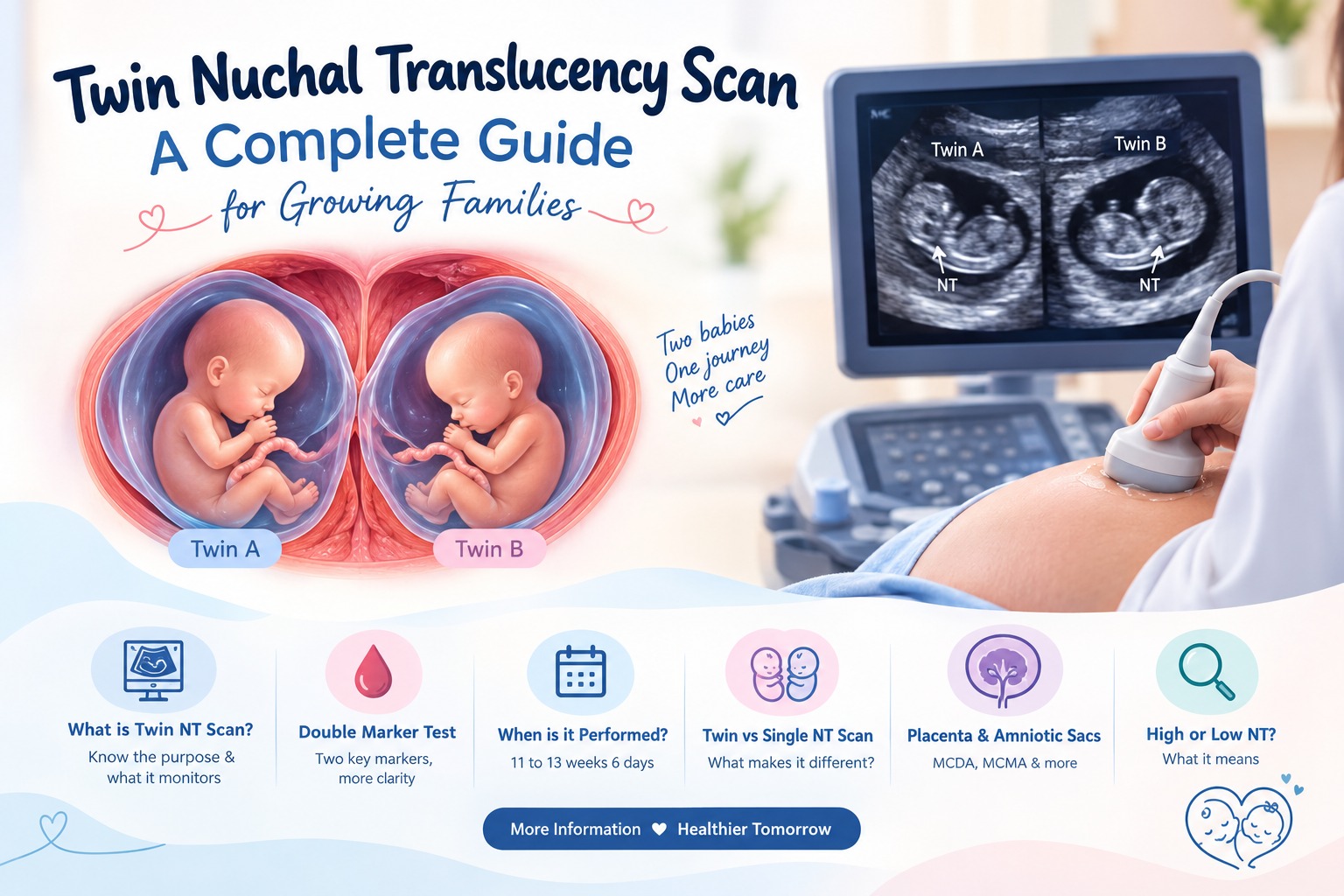
Nuchal Translucency Scan can also said in short term as (NT)scan monitors so many things, but Twin NT scan want some more attention and care to analyze and monitor the overall development of each baby in the mother womb it’s main thing is for to monitor the nasal bone of each baby in the first trimester may no other scans can’t play this major as perfect as the Nuchal Translucency (NT) Scan. A key point to remember is that if NT scan was missed no other scan is able to monitor the nasal bone as perfectly as NT scan so it has a separate role in monitoring the nasal bone, and Nuchal translucency scan (NT scan) also monitors and measures the fluid at the back of a fetus’s neck.
What Is the Double Marker Test and Importance After the NT Scan?
The Double Marker Test is a screening test that involves drawing blood to measure two different markers, Free β-hCG and PAPP-A, and uses them alongside maternal age and the NT scan results to determine chromosomal abnormality risks.
Why the NT scan and the Double Marker Test are both performed:
While the NT scan evaluates the ultrasound marker, the Double Marker Test analyzes two crucial biochemical markers in the mother’s blood. Both procedures are considered first-line screening methods for determining chromosomal abnormalities.
The most common chromosomal abnormalities detected by the Double Marker Test are:
Down Syndrome or Trisomy 21
Edwards Syndrome or Trisomy 18
Patau Syndrome or Trisomy 13
Remember that a Double Marker Test is a screening test and should not be considered diagnostic. In other words, a positive test result does not confirm that the fetus actually has one of the chromosomal abnormalities, while a negative test result cannot rule out any pregnancy complications. Only your doctor can analyze and interpret the results and determine the appropriate course of action.
When Is the NT Scan Performed?
The NT (Nuchal Translucency) scan is performed during the pregnancy between 11 weeks and 13 weeks 6 days.
This scan is done at this stage because the amount of fluid that accumulates at the back of the fetus’s neck, that is, the nuchal translucency increases with time until it disappears on its own. The size of the fetus should also be appropriate for the NT scan as it is performed when the fetus’s crown-rump length (CRL) is within the normal range.
How Does Twin NT Scan Different From a Single-Baby NT Scan?
The basic principle of NT scan measurement is the same, but a twin pregnancy requires additional attention and careful monitoring.
In a twin pregnancy, the sonologist needs to:
Identify both babies clearly.
Confirm the location and orientation of each fetus/baby.
Measure the crown-rump length of each fetus/baby.
Obtain an appropriate NT image for each baby.
Record the NT measurement separately.
As per the recommendation of ISUOG (International Society of Ultrasound in Obstetrics and Gynecology) To avoid confusion during future scans, the babies are given consistent labels, usually such as Twin A and Twin B. The doctor may also record where each baby is positioned, such as right and left or upper and lower, along with other features that help identify them.
What does the doctor examine during the NT Scan?
Doctors examine twin babies separately, how both babies overall development and growth, and also analyze key elements during the NT scan. This is how doctors look into the babies' amniotic sacs to analyse how each baby grows in their Placenta in the mother womb:
Examines the placenta/placentas:
The placenta can usually be called as(Mavi).
In some twin pregnancy cases each baby has its own. Placenta is nothing but the temporary organ baby through the umbilical cord; It gives the baby food and oxygen, takes away waste, and makes important hormones.
When both Two Babies have shared Two Placentas each one has its own it can be called “Dichorionic Twin Pregnancy.”
When two babies share only one placenta it can be called “Monochorionic Twin Pregnancy.”
Types of Amniotic sac’s:
MCDA - Monochorionic Diamniotic
The “Monochorionic Diamniotic” means when the twins are identical twins who share one placenta but live in two separate amniotic sacs. In simple terms the babies share one placenta, but each baby has its own separate amniotic sac.
MCMA - Monochorionic Monoamniotic
The “Monochorionic Monoamniotic” means when the twins are identical twins who share one common placenta and one single amniotic sac without a dividing membrane. It accounts for about 1% of all twin pregnancies, so it requires specialist assessment and closer monitoring.
What Does a High NT Measurement Mean?
The high NT refers to a situation where the measurement is bigger than the expected range. In other words, the fluid space behind the baby’s neck is bigger than normal for the baby’s age. An NT value of 3–3.5 mm or greater than the expected measurement is considered increased depending on the baby’s gestational age and screening method.
A high NT does not confirm that the baby has Down syndrome or some other chromosomal or structural abnormalities. It only indicates that the baby has higher chances of having those problems than average.
What Does a Low NT Measurement Mean?
There are a few things that a low or normal NT indicates: Firstly, it means that the amount of fluid at the back of the baby's neck is normal. Another thing it means is that it is a reassuring discovery.
Having a normal NT implies that there is a lower possibility that your child will have chromosome problems, in contrast to an increased NT level. There is a probability that your child will be diagnosed with Down syndrome and other chromosomal disorders. In simple words:
Normal NT → Good sign
High and low NT → Needs a closer look.
Conclusion:
Compared with the other normal single baby scans it varies from the twin baby scan; in the same perspective twin NT scans need more attention than normal single baby NT scans, because the doctor needs to monitor each baby independently. Not only the twin NT scan, every different kind of twin ultrascans needs some care and monitoring, so if you are carrying the twin babies do consult your personal doctor and regular checkup frequently.
Book your Nuchal Translucency Scan (NT scan) with Naren Ultrasound & Fetal Medicine Center and take this important step with expert guidance and confidence.
About the Doctor

Dr. Naren Satya
Consultant Radiologist
Naren Ultrasound and Fetal Medicine Center, Visakhapatnam
Related Topics