During the Pregnancy journey, mothers have so many questions in their minds about so many types of scans and which scan is useful for which purpose. During your pregnancy, your doctor may recommend various tests and scans in order to see your baby’s condition and to screen out potential complications. In such circumstances, an NT scan is also a scan that a doctor can recommend for taking extra caution regarding the baby’s overall development.
One of these tests is the Nuchal Translucency (NT) scan.
What is Nuchal Translucency Scan??
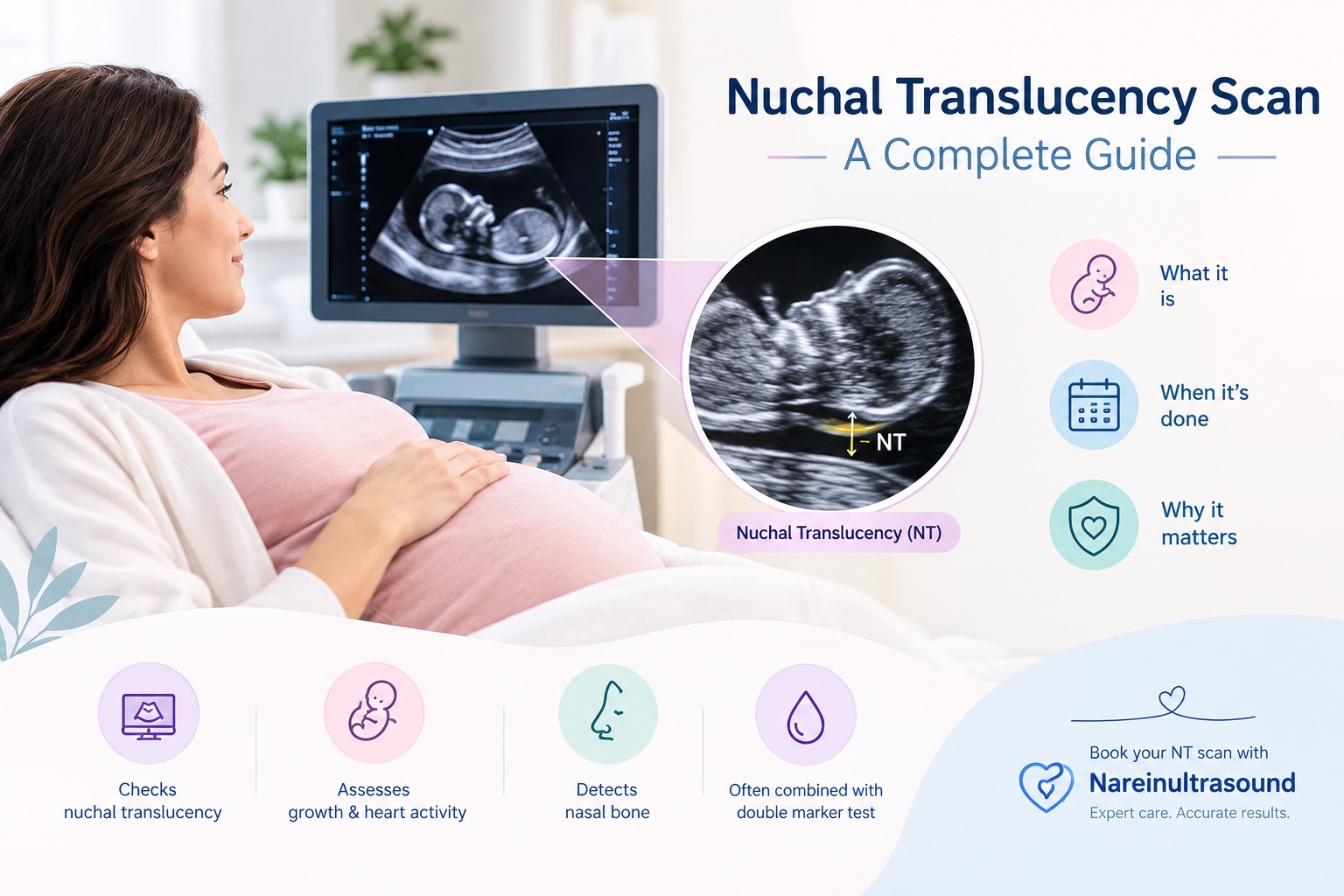
The NT scan is also an ultrasound scan, which is performed between 11 weeks and 13 weeks and 6 days of pregnancy in your first trimester. The NT scan has a specific identity and the only way to identify and notice the nasal bone is through the NT scan, it is the one and only scan which detect the nasal bone at a specific time, if it was missed to monitor in that particular time no scans may can’t able to detect the nasal bone.
During the NT scan in pregnancy, the doctor measures the amount of fluid at the back of your baby’s neck. During the NT scan, you may be able to see your baby move or see the heartbeat or the baby’s head, body, and limbs.
What Is the Double Marker Test and Importance After the NT Scan?
The Double Marker Test means it is a screening test that involves drawing blood to measure two different markers, Free β-hCG and PAPP-A, and uses them alongside maternal age and the NT scan results to determine chromosomal abnormality risks.
Why the NT scan and the Double Marker Test are both performed:
While the NT scan evaluates the ultrasound marker, the Double Marker Test analyzes two crucial biochemical markers in the mother’s blood. Both procedures are considered first-line screening methods for determining chromosomal abnormalities.
The most common chromosomal abnormalities detected by the Double Marker Test are:
Down Syndrome or Trisomy 21
Edwards Syndrome or Trisomy 18
Patau Syndrome or Trisomy 13
Remember that a Double Marker Test is a screening test and should not be considered diagnostic. In other words, a positive test result does not confirm that the fetus actually has one of the chromosomal abnormalities, while a negative test result cannot rule out any pregnancy complications. Only your doctor can analyze and interpret the results and determine the appropriate course of action.
Understanding a Nuchal Translucency Scan
A nuchal translucency scan (NT scan) is a test that uses ultrasound to measure fluid at the back of a fetus’s neck. The NT scan is performed to evaluate the amount of nuchal translucency present in a growing fetus.
This scan is carried out by taking an image of the fetus and then precisely measuring the thickness of the neck region. The doctor analyzes the obtained measurement of your NT scan in combination with your age and the age of your fetus to come up with the scan results.
Having an NT scan with a high measurement does not necessarily indicate that your baby has health problems. It only shows that your doctor will take extra caution and may perform additional procedures to screen out any potential complications.
When Is the NT Scan Performed?
The NT (Nuchal Translucency) scan is performed during the pregnancy between 11 weeks and 13 weeks 6 days.
This scan is done at this stage because the amount of fluid that accumulates at the back of the fetus’s neck, that is, the nuchal translucency, increases with time until it disappears on its own. The size of the fetus should also be appropriate for the NT scan, as it is performed when the fetus’s crown-rump length (CRL) is within the normal range.
Why Is the NT Scan Important?
A high NT scan is associated with an increased likelihood that the fetus has health problems, including chromosomal abnormalities, congenital heart defects, and other irregularities. Nevertheless, the NT scan result is only one of the factors considered in the overall detection process. The doctor considers several other factors such as:
Mother’s age:
The age of the fetus
The CRL measurement
Other ultrasound information
Test results of maternal blood tests
What Does the NT Scan Look For?
Although the main objective of the NT scan is to detect nuchal translucency, an early pregnancy ultrasound scan can also help to identify other potential problems that may be present. What the NT scan looks for includes the following:
Nuchal Translucency:
The doctor will begin by obtaining a lateral view of the fetus to measure the distance behind the baby’s neck.
Baby’s Growth:
The doctor uses the ultrasound to measure the fetus’s size, estimating the pregnancy’s age. One measurement that is utilized to assess the fetus’s size is the crown-rump length (CRL). The CRL is a measurement of the fetus’s length from the top of the head to the bottom.
Baby’s Heart Activity:
The baby’s heart activity can also be examined to determine potential irregularities in the fetus’s heart.
Baby’s Early Anatomy:
The position of the fetus as well as the scan’s quality will determine how much of the baby’s anatomy can be seen. In addition to the head, brain, spinal cord, abdomen, limbs, and other parts of the body, the scan may also be able to detect.
Your NT (Nuchal Translucency) scan contains a number of essential, common terms and measurements that we’ve chosen to review below: Terminology that May Be Used During the NT Scan.
CRL – Crown-Rump Length:
This is the measurement that describes the length of the uterus from the crown to the rump.
NT – Nuchal Translucency:
NT stands for Nuchal Translucency, which is a typical measurement taken behind the baby’s neck.
FHR – Fetal Heart Rate:
FHR refers to the fetal heart rate at which a fetus’s heart beats.
Gestational Age:
This is the estimated age of pregnancy at the time of scanning.
Conclusion:
The NT scan is a crucial test done in early pregnancy, which allows the doctor to get an idea of what is going on with the fetus and determine the risks of some diseases. And one of the main importance of this scan is to check the nasal bone condition and appearance in the first-trimester, if you missed this scan it may be impossible to check the update about nasal bone growth in any other ultrasound scans.
This ultrasound is performed to have an approximate idea of the fetus’s state, and it is essential to keep in mind that an NT scan is a screening procedure.
Book your Nuchal Translucency Scan (NT scan) with Naren Ultrasound & Fetal Medicine Center and take this important step with expert guidance and confidence.
About the Doctor

Dr. Naren Satya
Consultant Radiologist
Naren Ultrasound and Fetal Medicine Center, Visakhapatnam
Related Topics