During a twin pregnancy, every ultrasound scan can raise new questions for parents. When there are two developing babies, doctors closely assess each fetus individually in order to see how they are growing, developing and how healthy they are.
An early examination which a doctor may recommend is an Early TIFFA Scan. However, for a twin pregnancy, the examination is a careful assessment of the two fetuses, as well as the placenta and membrane arrangement of the pregnancy. But what exactly is a Twin Early TIFFA Scan, at which point in the pregnancy is it conducted, and how does it differ from the standard Twin TIFFA or anomaly scan ? Let's find out.
What Is a Twin Early TIFFA Scan?
A Twin Early TIFFA Scan is an ultrasound examination carried out at an early stage in the pregnancy to assess the developing structures of both of the fetuses.
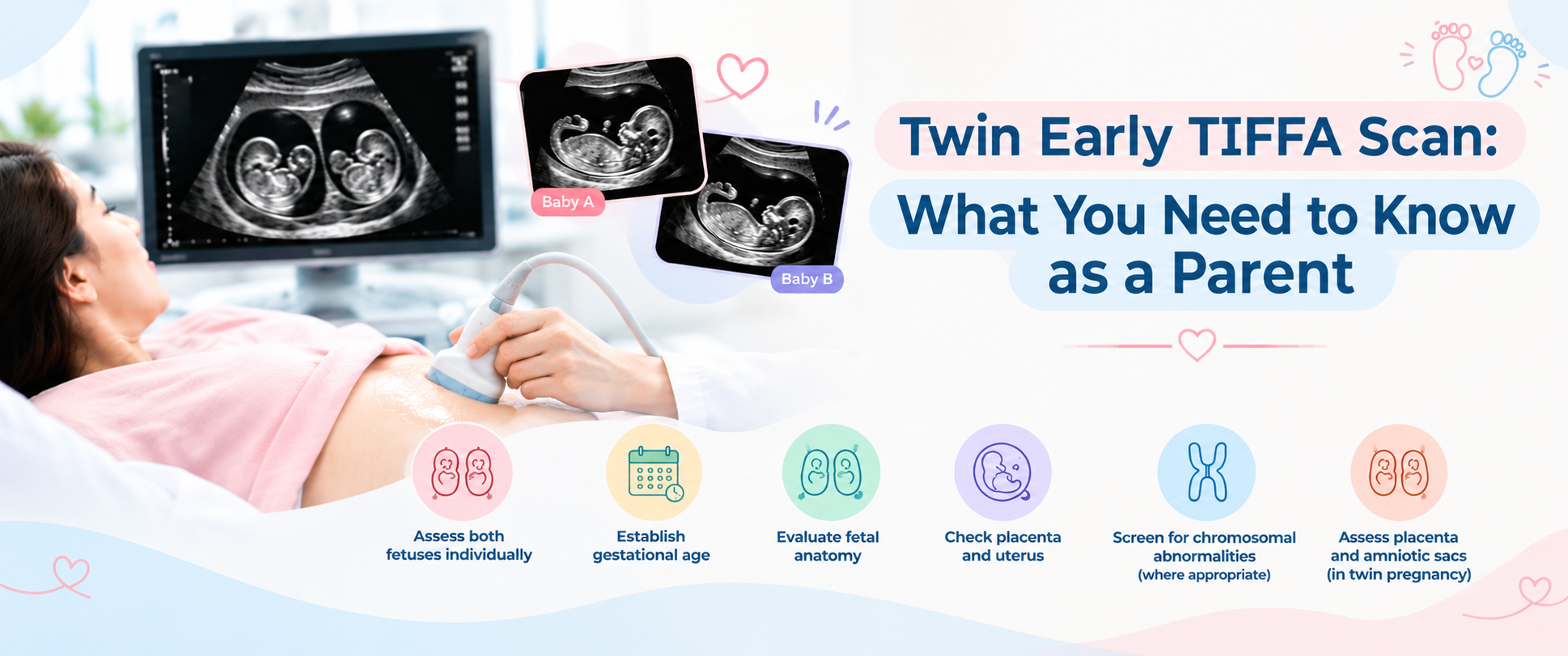
Early tiffa and early twin tiffa generally refer to a Targeted Imaging for Fetal Anomalies examination. An Early tiffa or twin tiffa Scan refers to a comprehensive ultrasound assessment of the fetus at the first trimester ISUOG (International Society of Ultrasound in Obstetrics and Gynecology) recommends an Early TIFFA Scan can establish gestational age, assess fetal anatomy, evaluate the placenta and uterus, and, when appropriate, assess markers associated with chromosomal abnormalities.
In a twin pregnancy, the doctor does not simply examine the pregnancy as a whole. Each fetus is assessed individually, as well as how the twins share the placenta and amniotic sacs. Depending on the situation and the type of assessment recommended by the doctor.
Why Is Early Assessment Important in a Twin Pregnancy?
A twin pregnancy requires close attention because two babies are developing at the same time. During the early ultrasound assessment, the doctor may evaluate:
The number of fetuses
Cardiac activity of each fetus
Fetal measurements
Early fetal anatomy
Fetal position
Placental arrangement
Number of amniotic sacs
Dividing membrane between the twins
Other features appropriate for the gestational age
One of the particularly important parts of assessing twins is determining chorionicity and Amnionicity.
These describe whether the twins share a placenta and whether they share an amniotic sac.
How Do Doctors Confirm a Twin Pregnancy?
Ultrasound is used to identify the number of fetuses developing inside the uterus.
One fetus: One developing fetus indicates a singleton pregnancy.
Two fetuses: Two developing fetuses indicate a twin pregnancy.
Once twins are identified, the doctor assesses each fetus individually and determines how the pregnancy is arranged.
The doctor may assess:
Cardiac activity → fetal measurements → early anatomy → placenta → dividing membrane → amniotic sacs.
This information helps establish an appropriate monitoring plan for the pregnancy.
What Does the Doctor Look for In a Twin Early TIFFA Scan?
1. Cardiac Activity of Both Babies: First, the doctor checks the cardiac activity of both babies. Since there are two babies, the doctor checks them individually instead of considering them to be one pregnancy. Additionally, this will help them to differentiate the two fetuses in future scans.
2. Growth and Measurements of Both Fetuses: The doctor measures the fetuses according to the gestational age.By doing this, the doctor determines if the fetuses are growing according to their gestational age.The doctor takes measurements of both fetuses and evaluates them comparatively.
Therefore, in case of any inequality in measurements, it does not mean there is something wrong. Instead, the doctor considers the gestational age and the overall state of the fetuses.
3. Early Fetal Anatomy:At this stage, the doctor can see the following fetal anatomy depending on the gestational age.For instance, the doctor can check the following:
Head and brain structure
Facial profile
Spine
Abdominal wall
Stomach and bladders
Limbs
Heart and some other structures
The extent of the anatomy to be checked depends on the gestational age, the position of the fetus, image quality, and the reason for scanning.It is essential to note that this scan is not a substitute for the anomaly scan done later in pregnancy.
4. Position of Both Babies: The doctor also looks at the position of the fetus or fetuses.It is normal for the babies to be in different positions since they still have enough room to move inside the womb.Therefore, a fetus can be either head down, breech presentation, transverse, or oblique.
It is not easy to determine the final delivery position of a baby from an early scan.
5. Placenta or Placentas
The doctor also focuses their attention on the placenta or placentas.
In most cases, twins can either share one placenta or have two separate placentas. The doctor looks at the chorionicity to determine which category the twin pregnancy falls.
Examines the placenta/placentas:
The placenta can usually be called as(Mavi). In some twin pregnancy cases each baby has its own. Placenta is nothing but the temporary organ baby through the umbilical cord; It gives the baby food and oxygen, takes away waste, and makes important hormones.
When both Two Babies have shared Two Placentas each one has its own it can be called “Dichorionic Twin Pregnancy.”
When two babies share only one placenta it can be called “Monochorionic Twin Pregnancy.”
Checks the amniotic sacs:
After complete checkup of the placenta doctor examines the membrane arrangement to determine how many amniotic sacs are present.
Amniotic sac is a kind of a thin, tough, transparent pair of membranes (the inner amnion and outer chorion) inside the uterus that surrounds, protects, and supports a developing fetus during pregnancy;the Amniotic sac is filled with the Amniotic fluid The amniotic fluid cushions the baby and protects the baby in the mother's womb.
Types of Amniotic sac’s:
MCDA - Monochorionic Diamniotic:
The “Monochorionic Diamniotic” means when the twins are identical twins who share one placenta but live in two separate amniotic sacs. In simple terms the babies share one placenta, but each baby has its own separate amniotic sac.
MCMA - Monochorionic Monoamniotic:
The “Monochorionic Monoamniotic” means when the twins are identical twins who share one common placenta and one single amniotic sac without a dividing membrane. It accounts for about 1% of all twin pregnancies, so it requires specialist assessment and closer monitoring.
Conclusion:
If your doctor recommends an Early TIFFA Scan, not to worry. It is just a chance to see how your baby is developing in their earliest stages, and work out if there is anything that needs closer monitoring. Your doctor can also speak to you about if it's right to have other screening or follow up scans for your situation.
Book your First Early Twin Tiffa scan with Naren Ultrasound & Fetal Medicine Center and take this important step with expert guidance and confidence.
About the Doctor

Dr. Naren Satya
Consultant Radiologist
Naren Ultrasound and Fetal Medicine Center, Visakhapatnam
Related Topics