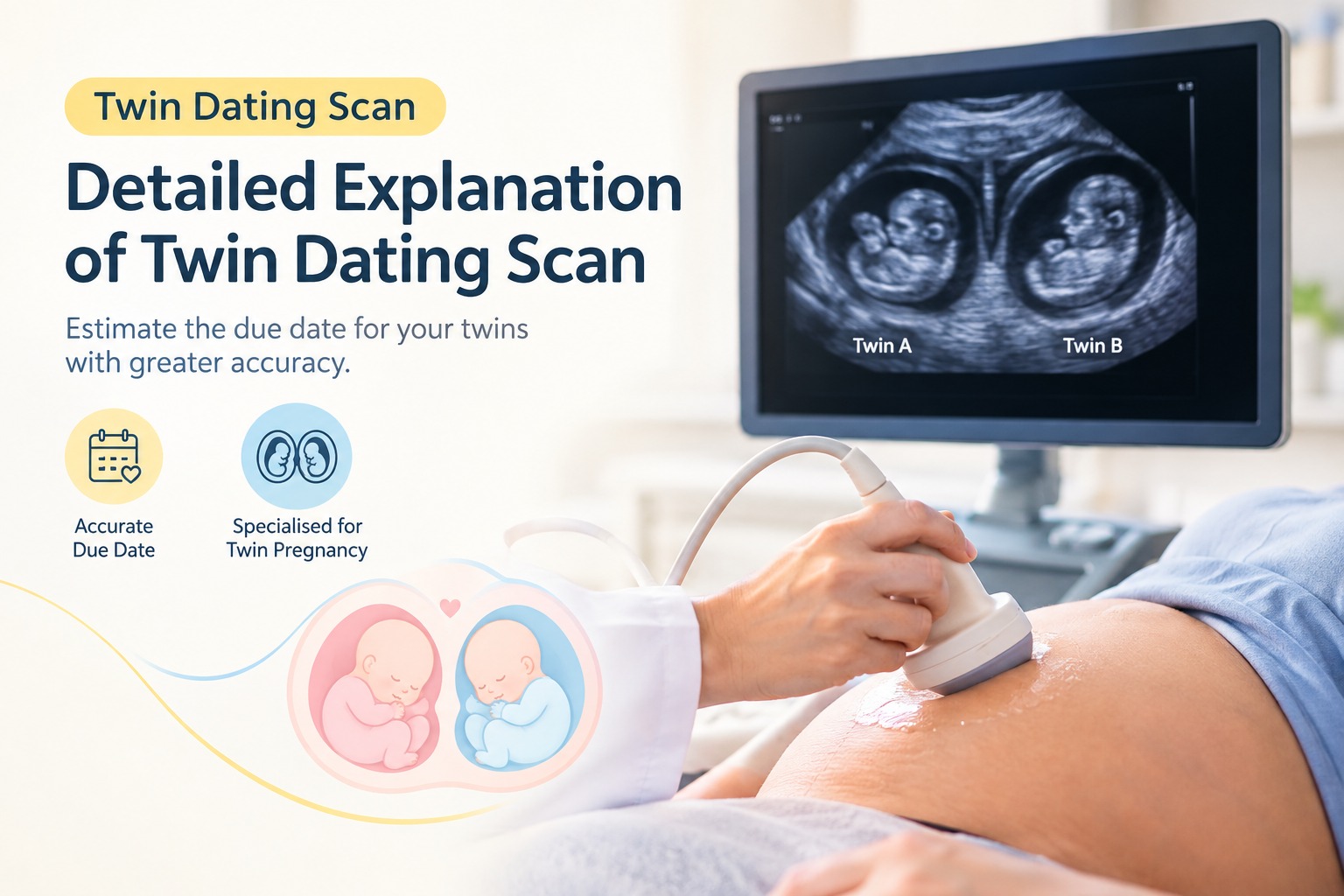
Mainly, dating scans are of two types: the first is the dating scan, and the second is the twin dating scan. The primary goal of both dating scans is to estimate the expected due date of the baby. The dating scan is used for a single pregnancy, but the twin dating scan is for a twin pregnancy; it differs from the single dating scan, so it is difficult to take careful measures to estimate the expected due date of the twin babies.
What Is a Twin Dating Scan?
A Twin Dating Scan is performed during the early stage of the pregnancy to determine the gestational age of a twin pregnancy and an estimated due date. In the first trimester, one of the most important measurements is the crown-rump length (CRL), which measures the fetus from the top of the head to the bottom of the baby in the mother's womb.
When Is a Twin Dating Scan Usually Performed?
In the first trimester, it occurs between weeks 8-13 of your pregnancy, with the most accuracy between 10-12 weeks.
Key Things a Twin Dating Scan Helps Determine
1. Identifying Both Fetuses:
During the twin dating scan, the doctor’s primary goal is to identify both babies in the mother's womb. As per the recommendation of ISUOG (International Society of Ultrasound in Obstetrics and Gynecology), to avoid confusion during future scans, the babies are given consistent labels, usually such as Twin A and Twin B. The doctor may also record where each baby is positioned, such as right and left or upper and lower, along with other features that help identify them.
2. Estimating Gestational Age:
During the first trimester, crown-rump length (CRL) is an essential parameter for dating pregnancy. The doctor observed that both babies' crown-rump lengths (CRL) can be monitored in detail, and after detailed monitoring of both babies, the doctor is able to determine the date of gestation and the time of conception for both twin babies.
3. Estimating the Expected Due Date:
Once gestational age has been calculated, the doctor calculates the estimated due date (EDD) of both twin babies. The due date is an estimate rather than an indication of the day that the babies will be born at a specific time spontaneously. Its primary purpose is to give the mother a standard for reference on her pregnancy and for the required assessments.
4. Checking the Location of the Pregnancy:
An early ultrasound can help confirm that the pregnancy is indeed in the uterus. The ultrasound specialist examines the gestational sacs and the developing embryos or fetuses and their relation to the uterus and other structures.
This is important, especially in early pregnancy, since determining the location of the pregnancy is part of evaluating the pregnancy's early progress.
Conclusion:
A Twin Dating Scan is a much simpler way of determining the due date of the pregnancy for parents.
It allows medical professionals to see an early picture of the pregnancy and provides them with a baseline of information for managing the pregnancy and caring for each fetus throughout the development process.
Book your first Dating scan with Naren Ultrasound & Fetal Medicine Center and take this important step with expert guidance and confidence.
About the Doctor

Dr. Naren Satya
Consultant Radiologist
Naren Ultrasound and Fetal Medicine Center, Visakhapatnam
Related Topics