
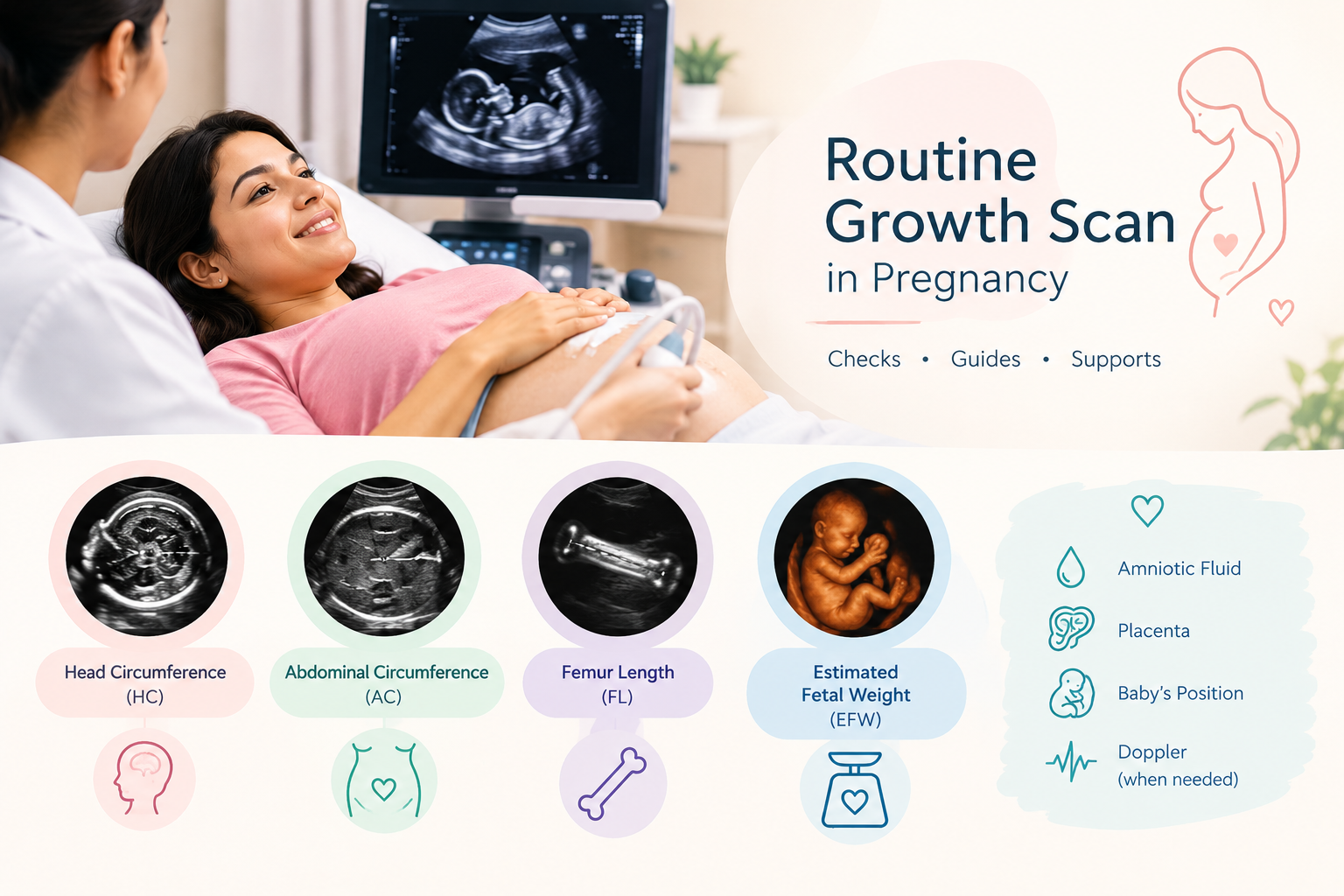
A routine growth scan is an ultrasound examination that is carried out to evaluate your baby's growth and wellbeing in pregnancy. The scan includes consideration of fetal measurement, estimated weight, amniotic fluid and other factors which your doctor can use to determine how the pregnancy is progressing.
Pregnancy does not progress in the same way for each mother or for her baby. Some babies are simply smaller or larger, while others have unique requirements which may require further monitoring.
A growth scan in pregnancy provides your doctor with insight on the size and growth pattern of your baby and can also assist in determining situations where more monitoring is required.
What Is a Routine Growth Scan?
A routine growth scan refers to an ultrasound examination focussing primarily on fetal growth and wellbeing.
As such the scan includes measuring the body of the baby to estimate fetal size and may also include the assessment of the amniotic fluid, placenta, position of the baby and the flow of the blood using Doppler if required.
A routine growth scan refers to ultrasound assessment of fetal biometry and growth as an integral part of identifying conditions such as Fetal Growth Restriction (FGR), small-for-gestational-age (SGA) and large-for-gestational-age (LGA) fetuses.
What Is Fetal Growth Restriction (FGR)?
Fetal Growth Restriction (FGR) can be described as a condition where the fetus is not growing properly in the womb due to a problem or abnormality.One of the most common causes of FGR is placental insufficiency; the placenta is failing to provide the fetus with the required oxygen and nutrients.
There are also causes related to maternal, fetal, and other pregnancy related complications. Therefore, if a doctor detects that the fetus is small for gestational age in an ultrasound scan, it does not necessarily mean that there is fetal growth restriction.
In addition, the doctors make a distinction between Small for Gestational Age and FGR. Although similar, these are two different terms which describe various conditions.
What About a Large Baby? – LGA
The terms discussed above relate to babies that are born smaller than average, but what about ones that are larger? Fortunately, most large babies are not abnormal in any way. A fetus that is big for gestational age is commonly described as Large for Gestational Age (LGA)
Generally speaking, this term refers to a fetus or infant whose measurements are higher than the established percentiles for gestational age. Simply put, an LGA baby is bigger than most other babies born at the same gestational age.
Therefore, it is crucial to remember that the determination of the fetal size should not be based on a single parameter. Instead, to evaluate fetal growth, doctors compare the ultrasound results to a standardized growth chart.
What Does Small-for-Gestational-Age (SGA) Mean?
For those wondering what small for gestational age means, it is used to classify a fetus that has a lower weight and abdominal circumference than most other fetuses of the same gestational age. According to the standard definition, an SGA fetus has an estimated fetal weight (EFW) or abdominal circumference (AC) below the 10th percentile.
Having a low percentile does not necessarily mean that something is wrong with the fetus, as there are some babies that are naturally small for their gestational age. These are commonly referred to as constitutionally small adults, and their low weight and height percentile is typical for them.
Therefore, if a doctor detects signs of an SGA fetus in a growth scan, it is crucial not to jump to conclusions. In reality, the doctor will analyze the percentile in relation to the baby’s growth and gestational age and other ultrasound results.
What Does a Growth Scan Check?
A fetal growth scan may include the assessment of several features.
1. Baby's Growth Measurements:
The ultrasound measures parts of the baby's body such as:
Head measurements
Abdominal circumference
Femur length
Other appropriate fetal measurements
These are used to assess fetal growth and to calculate an estimated fetal weight.
2. Estimated Fetal Weight:
A growth scan may be able to provide an estimate of your baby's weight (EFW). It is important to remember that this is an estimate and not an actual measurement of the baby's weight.
The estimated weight should be interpreted in the context of the baby's gestational age and appropriate growth standards rather than just looking at the number.
The calculation in conjunction with your baby's gestational age, previous measurements, growth, amniotic fluid, Doppler studies if applicable, and other factors will be used to assess your baby's growth rate.
3. Amniotic Fluid:
The scan may also assess the amount of amniotic fluid surrounding the baby. Amniotic fluid assessment is an important part of later pregnancy ultrasound and can be reported as normal or abnormal with measurements such as the deepest vertical pocket or amniotic fluid index being used appropriately.
Amniotic fluid is the clear, pale yellow liquid that surrounds an unborn baby inside the amniotic sac. It protects the baby throughout the delivery period from harm, keeps them warm, and helps their lungs, muscles, and bones grow properly and it also cushions the baby against hard pressure from uterine contractions.
4. Placenta:
The placenta may also be assessed as part of an ultrasound examination. Placenta is nothing but the temporary organ baby through the umbilical cord; It gives the baby food and oxygen, takes away waste, and makes important hormones.
The doctor may be looking to observe its position and other features appropriate to the stage of pregnancy and reason for the scan.
5. Fetal Wellbeing:
A growth scan provides information on fetal size and other ultrasound findings which contribute towards the overall assessment of pregnancy. Depending on the situation the examination may also include assessment of the fetal movement, presentation, amniotic fluid and Doppler blood-flow studies.
It just means that they are measuring your developing baby. They will take measurements of your head, abdomen and femur to measure the size of the fetus to determine an estimated fetal weight.
The measurements are related to your gestational age and growth standards and are not taken individually.
Conclusion:
A developmental scan can tell you how far along your baby is, approximately how big he or she is and how much fluid and overall wellness is inside the womb. Every child has his or her own pattern of growth, so any abnormal scan does not necessarily indicate a problem.
If you have any questions or concerns regarding a growth scan or a child's wellbeing, consult your personal doctor or obstetrical physician for a professional opinion in a particular case.
Common Questions:
1. What Is Estimated Fetal Weight?
Estimated fetal weight or EFW is an indication calculated using the measurements taken during the ultrasound. It should also be noted that the weight is an estimate and due to the nature of the calculation, the calculation should not be considered an accurate representation of the baby's weight.
2. Why is fetal growth monitored?
It is normal for all babies to be within a range of sizes. If your baby is measuring to be small it does not necessarily mean that they are not growing properly.
All babies have different growth rates, some may be consistently smaller while others may have growth restriction or other factors affecting their growth.
3. Is a growth scan necessary for every pregnancy?
Not necessarily, the need for and timing of additional growth scans will depend on the individual circumstances of your pregnancy.
Book your first Routine Growth Scan with Naren ultrasound And Fetal Medicine Center and take this important step with expert guidance and confidence.
About the Doctor

Dr. Naren Satya
Consultant Radiologist
Naren Ultrasound and Fetal Medicine Center, Visakhapatnam
Related Topics