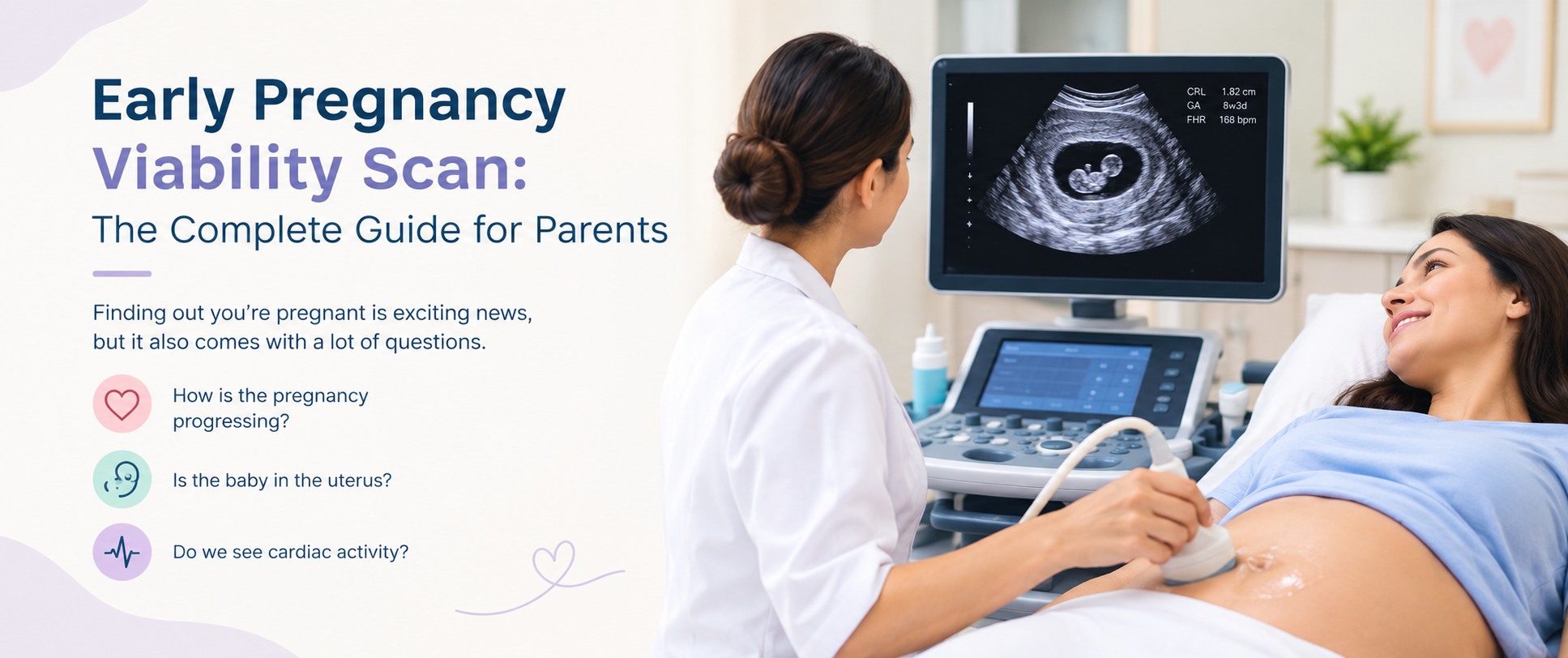
Finding out you’re pregnant is exciting news, but it also comes with a lot of questions.
How is the pregnancy progressing?
Is the baby in the uterus?
Do we see cardiac activity?
A lot of these questions can be answered with an early pregnancy ultrasound, often called a viability scan. It uses ultrasound imaging to determine the location and early development of the pregnancy, and when the pregnancy is sufficiently advanced to do so, to look for embryonic or fetal cardiac activity.
What Is a Viability Scan?
A viability scan is an ultrasound scan, which is done early in pregnancy to check the progress of the pregnancy within the womb. It is primarily done to ascertain the location of the pregnancy, along with the gestational sac, the presence of an embryo, and the fetal heartbeat, if present.
It can help to confirm:
Pregnancy location → Early development → The embryo → The CRL → Cardiac activity → Possible early complications.
Your doctor or sonographer may check for:
Pregnancy location check: To determine if the pregnancy is intrauterine (inside the uterus/womb).
Gestational sac check: Checks for the small fluid-filled sac, which is a place of conception.
Yolk sac check: Looks for the small sac that supplies food to the embryo during the early stages of pregnancy.
Embryo check: Confirms the presence of the developing baby within the gestational sac.
Crown rump length (CRL) measurement: Measures the length of the embryo from crown to rump to determine the gestational age.
Cardiac activity check: Determines if the heartbeat of the embryo or baby is present; it should be visible at the gestational age.
Number of pregnancies check: Confirms if the pregnancy is single or multiple.
Uterine and adjacent structures check: Evaluates the uterus and the surrounding structures for any additional concerns.
Early pregnancy complications check: Screens for potential complication signs, such as ectopic pregnancy or bleeding during pregnancy.
The American College of Obstetricians and Gynecologists (ACOG) states that viability ultrasound is the preferred method of confirming an intrauterine environment: The physical space and conditions inside the womb where a fetus develops.
While the term “viability scan” is often used, it is not correct to refer to this procedure since the definition of viability does not apply to embryos. The preferred terms are either early pregnancy ultrasound or first-trimester ultrasound.
When Is a Viability Scan Usually Done?
There is no one week pregnant when every woman must have a viability scan. The scan is usually guided by the reason for the scan, any symptoms, previous scans, dating of the pregnancy, fertility treatment, and the impression of the doctor. Scanning too early can also give a false negative result.
For example, NICE guidelines (the National Institute for Health and Care Excellence ) recommend performing a second scan before diagnosis of a miscarriage in cases where the initial scan does not confirm pregnancy viability. For instance, a transvaginal scan that reveals an embryo measuring below 7 mm crown-rump length (CRL) with no heartbeat should be followed by another scan within 7 days because the signs of miscarriage may not be evident on an early scan.
What If There's No Heartbeat Seen?
Not being able to see a heartbeat at an early scan can be disheartening, but it does not always mean that your pregnancy has failed. Sometimes it can just be too early to see a heartbeat. Your doctor will take into account how many weeks pregnant you are, the size of your embryo and gestational sac, any previous scans, and what type of scan you had.
If there is still no heartbeat seen, then NICE recommends a scan again at certain points before labelling it as a miscarriage. Therefore, a scan may be recommended again to get a better look at how your pregnancy is progressing.
Conclusion:
A viability scan can confirm the location of the pregnancy, whether an embryo is present, how far along you are, and whether there is a heartbeat at that stage of pregnancy; it can also rule out some pregnancy complications.
If you have any concerns regarding your early pregnancy, please cross-check with your doctor or ultrasound specialist. All pregnancies are different, and the timing and results of your scan will always be considered within the correct clinical context.
Book your First Viability Scan with Naren Ultrasound & Fetal Medicine Center and take this important step with expert guidance and confidence.
About the Doctor

Dr. Naren Satya
Consultant Radiologist
Naren Ultrasound and Fetal Medicine Center, Visakhapatnam
Related Topics